
By jettisoning the seniority principle, the government has sent a strong signal that only merit and suitability will count in occupying posts in the higher echelons of the military, writes national security expert Nitin Gokhale.

Defence Minister Manohar Parrikar on Monday mooted the idea of raising an all women battalion and stationing of women on warships besides opening the doors of the National Defence Academy and Sainik schools for them.
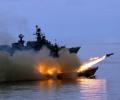
An impressive array of warships, including nuclear capable submarines, and about 8000 men and officers of Indian Navy presented an exquisite display of operational capabilities in an exercise reviewed by Prime Minister Narendra Modi off the Kochi coast in Kerala on Tuesday.

'It is the government's most important duty to ensure that when war breaks out, the armed forces are absolutely ready to face the adversary -- well equipped, well trained and in high spirits,' says Brigadier Gurmeet Kanwal (retd).

Xi, the General Secretary of the Communist Party of China, called the progress China had made under his watch "truly remarkable
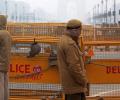
A red alert was sounded in the national capital over intelligence inputs of a possible terror strike which threw Delhi Police and other security agencies into a tizzy on a day when multiple attacks by militants in Jammu and Kashmir left several persons dead.
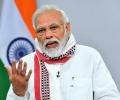
The military brass is learnt to have apprised Modi about the evolving situation in eastern Ladakh, though officials maintained that the agenda of the pre-scheduled meeting was to discuss the ambitious military reforms and ways to boost India's combat prowess.
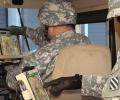
'... it must network its battlefield units quickly, securely, robustly,' notes Ajai Shukla.

India was fooled into believing that Communist China wanted a 'negotiated' settlement with the Tibetans; it was never the case, says Claude Arpi.

The majestic Rajpath saw a scintillating display of India's military might as the country celebrated its 69th Republic Day on Friday, with the leaders of all the 10 countries of the ASEAN attending the parade. Take a look here.

Pakistan perceives that if it had declared Gilgit-Baltistan, PoK or both, which are only a part of the territories of J&K, as legitimate provinces of Pakistan it would weaken its case for the entire J&K and lead to legal complications, observes Lieutenant General Syed Ata Hasnain (retd).

In a subtle show of strength to China, the Indian Air Force on Tuesday landed its C-130J Super Hercules transport plane at the world's highest and recently-activated Daulat Beg Oldie airstrip in Ladakh near the Line of Actual Control, the scene of a stand-off with Chinese troops in April.

'I do not agree that the intent was to send a political message to China that the US treats friends and foes alike.' 'In any case, such acts do not ruffle a feather in China,' observes Commodore Venugopal Menon (retd).

'In a war of guerrilla resistance from 1682 to 1707, the Marathas destroyed the foundations of the Mughal empire.' 'Shivaji was dead, but his example and ideals survived and were the main source for inspiration for the Marathas in their desperate struggle with the mighty Mughal empire,' notes Colonel Anil A Athale (retd), the well known military historian.
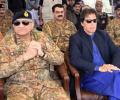
'It is not difficult for a Pakistan army chief assisted by the deep state to manipulate a situation.' 'Pulwama, Uri and Pathankot, all come to mind,' cautions Lieutenant General Syed Ata Hasnain (retd).

'Let us remember that Make in India for defence must not be our goal.' 'The goal is to have a strong military to help the nation protect its identity and assert its will.'

The Afghan deputy foreign minister explains how his nation's President became disillusioned with Pakistan. Ajai Shukla listens in.
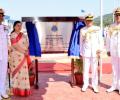
'The Andamans are strategic territory for India.' 'We need at least three full-length, 10,000-feet airfields here.'

He also said it was important that even during the difficult moments of this "crisis" India has been communicating and engaging with China.

'Ensuring through diplomatic means and in conjunction with strategic partners that India will not be required to fight a simultaneous two-front war with China and Pakistan.' Brigadier Gurmeet Kanwal (retd) lists what India must have in its national security strategy.
